In most people's minds, lubrication involves oil. A slick, viscous substance designed to keep moving parts from grinding against each other. Seawater, on the other hand, is corrosive. It rusts metal, degrades components, and generally seems like the last thing you’d want near your precision ship systems.
So how can seawater be used for lubrication? Doesn’t it just make everything rust?
At AEGIR-Marine, this question is more than theoretical. It’s a subject that the company’s R&D team has extensively worked on, resulting in effective, reliable and environmentally safe seawater lubricated stern tube seal systems.
A conversation with AEGIR-Marine Research & Development Engineer Seran Ünal and Technical Engineer Sheila Reig gives us the answers to our questions. Spoiler alert: it comes down to innovative materials, changes in design philosophy, and environmental priorities.
A solution that’s not as crazy as it sounds
Starting off with the most obvious question of ‘how does seawater lubrication work?’, Seran replies by explaining that “in a seawater-lubricated stern tube system, seawater replaces oil completely as the fluid that reduces friction”. This has called for some significant design changes. “The propeller shaft turns inside bearings specifically designed to run in water; the shaft seals are also designed for water instead of oil,” she adds. The upside is that “water naturally cools and lubricates the components, eliminating the need for oil tanks or oil circulation systems”.
In short: the whole system runs on water instead of oil. This has been made possible by the development of new materials.
Research + development = innovative materials
Seawater lubrication isn't a new concept, but it’s only become technically viable in recent decades. The breakthrough came from advanced composite bearing materials that function reliably with only seawater. Twenty or thirty years ago, the materials simply weren’t there. Seran: “Seawater lubrication is possible today thanks to advanced composite bearing materials that function reliably with only seawater.” Key innovations include:
- Composite bearings engineered to work with seawater
- Advanced elastomers for water-compatible sealing lips
- Hard coatings on liners that resist corrosion and wear
These materials allow components to operate smoothly even with water as the only lubricant – something that would have caused rapid failure in older systems.
Seawater lubrication in today’s shipping industry
Seawater lubrication is well-suited to many vessel types operating today. “Ferries and Ro-Pax vessels, cruise ships, inland and coastal vessels can all operate with seawater-lubricated systems,” says Sheila. However, it’s not a silver bullet that can be used on every type of ship. “High-speed craft, tankers and container ships may face technical restrictions related to shaft speed, axial and radial shaft movements and draft limitations.”
While oil-lubricated systems offer predictable reliability and long service life due to superior lubrication properties and decades of operational experience, their weak point is seal integrity and the risk of oil leakage. Sheila: “Modern seawater-lubricated systems can achieve comparable service life for bearings and seals when properly designed and operated, with the added benefit of eliminating pollution risk.”
“However, water-lubricated systems are more sensitive to alignment, shaft surface condition and water quality. Their reliability depends more strongly on installation quality and operating environment,” says Sheila. This is why seawater lubrication remains primarily a newbuild solution. “Retrofits are realistic but uncommon, as switching from oil to water requires a full redesign of the stern tube: bearings, seals, shaft alignment, water flow and monitoring systems.”
What does a ship engineer need to know to about seawater lubrication?
Because seawater lubrication brings specific technical requirements, Seran lists the most important aspects that a ship’s engineer must keep track of:
- Clean seawater intake must be ensured
- Shaft or sleeve surfaces must be suitable and well-maintained
- Systems are sensitive to misalignment and shaft vibration
- Materials must be specifically designed for water operation
In day-to-day operations, crews typically notice little difference if the system is properly designed and maintained. Oil systems require regular oil level checks, refills and periodic oil testing. Water systems eliminate these tasks, though attention to seawater quality and shaft condition becomes more critical.
The pros and cons of seawater lubrication
Beyond stern tubes and specialised seawater shaft bearings – such as rudder bearings – widespread seawater lubrication of major ship machinery remains limited. “This is because most vessel machinery still needs oil, which provides effective friction reduction and wear protection in dynamic, high-load and high-speed contacts,” explains Sheila. “Seawater’s lubricity is far lower than oil.” Therefore, oil lubrication makes more sense in certain cases:
- When the ship was not designed for water lubrication from the outset
- If the shipowner wants compatibility with existing oil-based service infrastructure
- Where operational conditions exceed the technical limits of current water-lubricated systems
That’s not a reason to rule out the usefulness of seawater though. “Seawater serves many other roles on board: machinery cooling circuits, ballast systems, firefighting systems, and conversion to fresh water through reverse osmosis. Using water where appropriate saves weight and space by reducing the need for large storage tanks,” says Sheila.
The environmental case
Looking outside the ship itself towards its surrounding environment, a crucial fact regarding oil-lubricated stern tubes is that they leak. It’s not a question of if, but how much. “Due to their design, oil seeps into the sea, with leakage rates that can reach up to 1% of the seal diameter per day,” notes Seran. “It is estimated that oil pollution from normal operations of oil-lubricated stern tube seals exceeds 80 million litres per year worldwide.”
Seawater lubrication eliminates this completely as there is no oil to leak. For vessels operating in sensitive waters – coastal areas, marine protected zones, or routes with strict environmental regulations – this is a decisive advantage. “International regulations, including the VGP [Vessel General Permit] in the United States, increasingly promote the use of EALs [environmentally acceptable lubricants], air lubrication systems or water-based lubrication to reduce this impact,” says Sheila. “Seawater lubrication is one of the cleanest solutions available.”
AEGIR-Marine's approach
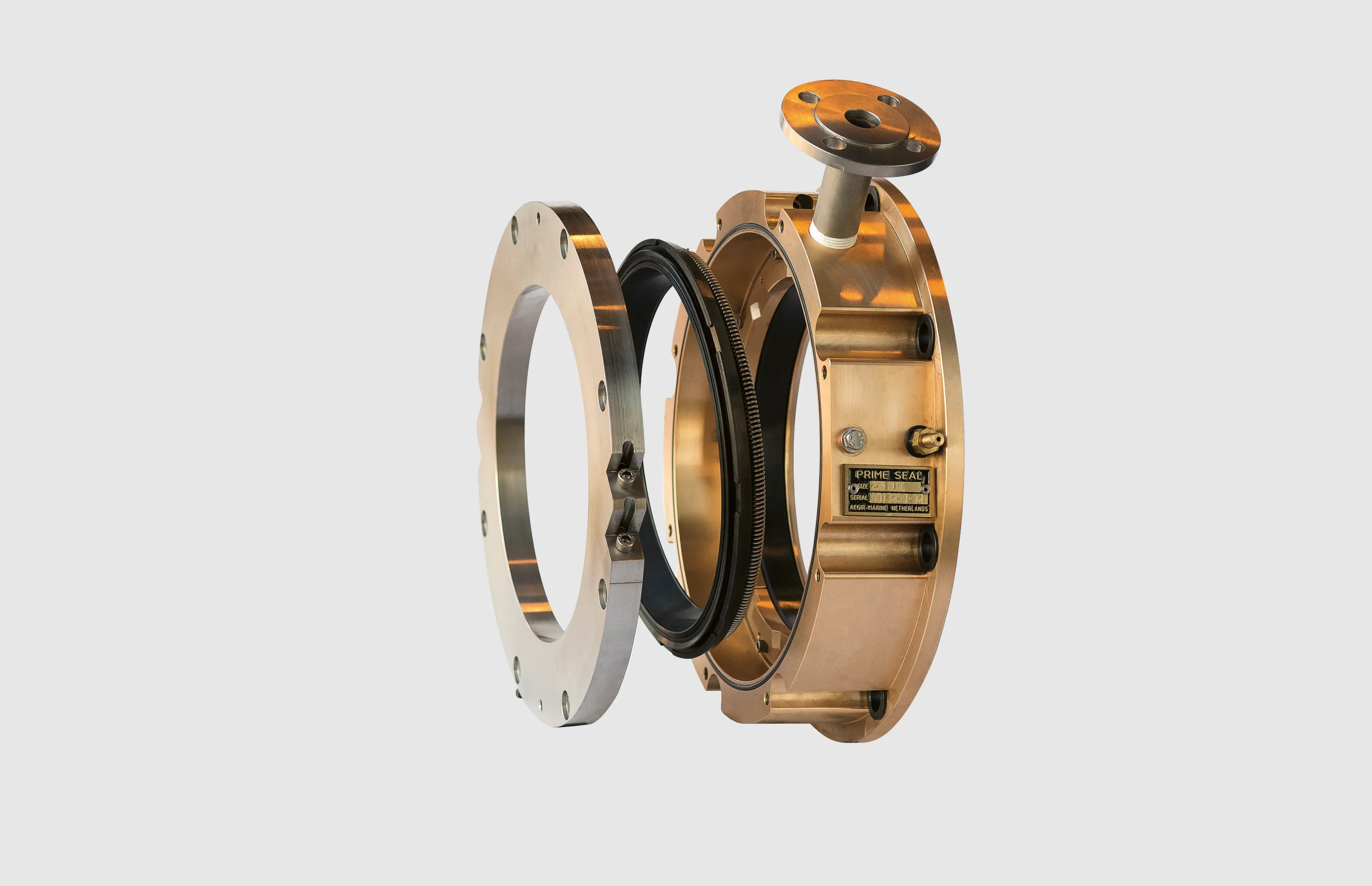
AEGIR-Marine's contribution to the seawater lubrication question is its Prime Blue System that has been designed specifically for water-lubricated stern tube seals. “We service vessels with water-lubricated systems, regardless of whether our equipment was installed at delivery,” says Seran. “We can also design and provide water-lubricated bearings, along with technical guidance and support during installation.”
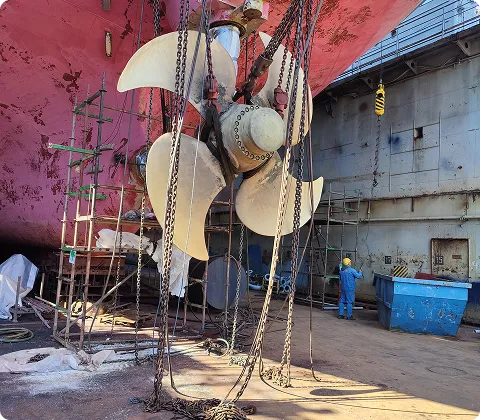
The practical differences relating to service and maintenance are notable. “Oil-lubricated systems require two seal housings,” notes Sheila. This consists of one aft (outside the vessel, between the propeller and stern frame) and one forward (inside the vessel). “Performing service or repairs typically requires drydocking or afloat work using scaffolding when the vessel is trimmed and the stern tube oil is fully drained.”
“Water-lubricated systems, on the other hand, need only one seal housing, located inside the vessel,” she continues. When service is required, an inflatable seal can be deployed for repairs afloat. “By inflating the seal against the shaft using air pressure, it stops seawater from entering through the open stern tube, making maintenance significantly easier.”
Where R&D is heading
For AEGIR-Marine’s five-person R&D team, their focus is on material development for both bearings and seals. Cooperating with research institutes, technical universities and industry partners, research is concentrated on:
- Better composite materials with improved durability
- Improved seal designs for longer life
- Digital monitoring of shaft and bearing condition
- Optimising friction under water-lubricated conditions
Over the next five to ten years, the priorities are clear: “Longer seal and bearing life, even better resistance to contaminated seawater, smarter monitoring systems that warn crews before issues arise, and new materials with lower friction in water,” concludes Seran.
A practical, reliable and environmental solution
Seawater lubrication represents a shift in how we think about stern tube systems. It’s not a perfect solution for every vessel, but where it works, it works well. The environmental benefit is measurable and immediate. The operational trade-offs are manageable with proper design and maintenance.
For shipowners navigating tightening environmental regulations and for crews maintaining vessels in ecologically sensitive areas, seawater lubrication offers a proven alternative. It’s a technology that has moved from niche application to viable standard a – one that AEGIR-Marine continues to refine, support and advance.